
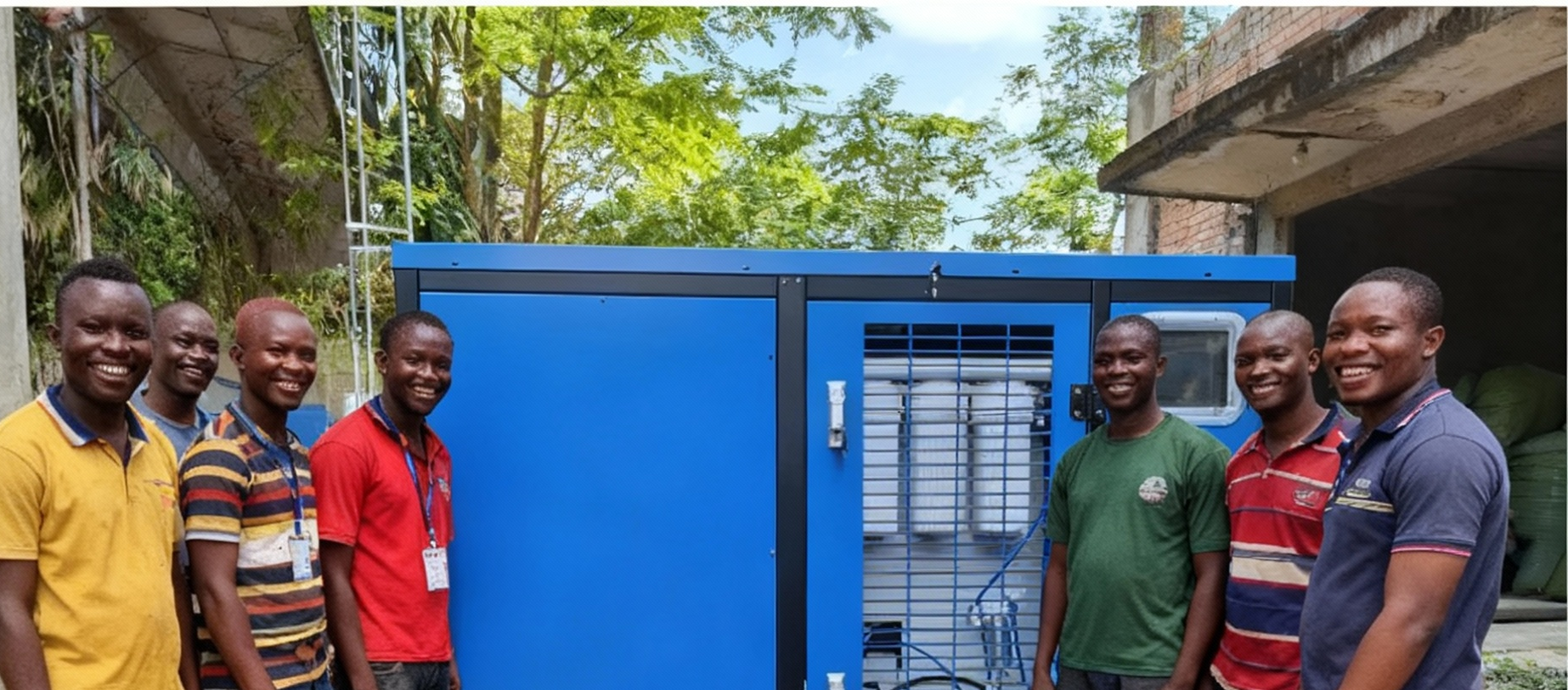
Atmospheric Water Generation (AWG) Pilot
The Clean Water Access AWG Pilot is a practical, evidence-led initiative to make safe drinking water reliably available for clinics, schools, and public service points in high-humidity zones of West and Central Africa. We pair energy‑efficient atmospheric water generators with solar or reliable grid power, a robust WHO‑aligned treatment train, and local O&M training. The result is dependable, on‑site potable water that reduces time burdens on women and youth, lowers waterborne disease risk, and strengthens essential services. Each pilot site targets 300–500 liters per day with rigorous monitoring of quality, uptime, and cost per liter. Your partnership converts a modest, well‑managed investment into measurable health gains, time savings, and a clear playbook that municipalities and national programs can scale.
Overview & Scope
Status
Ongoing — pilot planning and technical developmentRegion
West and Central Africa (humid coastal and sub‑humid inland communes; clinic/school compounds)Pilot Scale
2–3 sites per country (clinic, school, or administration office)Timeframe
Approximately 12–18 months (3 plan & test, 6–9 implement, 3–6 monitor/learn)
Technical & Costing
System
• Commercial AWG sized for 300–500 L/day at local humidity.
• Solar + battery or reliable grid; target ≤0.5–0.8 kWh/L.
• Filtration → UV → remineralization → residual chlorine; sealed storage and safe dispensing.Operations
Local operator with stipend, quarterly PM, basic water-quality kit, spare parts on site.Indicative costs
• Flow + kWh meters; log liters/day, energy, cost/L, uptime.
• Equipment $50k–$110k; power $40k–$100k; install/training $10k–$25k; consumables/M&E $10k–$20k.Total
$120k–$250k per site; working CPL $0.06–$0.20/L in humid settings.
Beneficiaries & Reach
Estimated direct beneficiaries
• 5,000–10,000 residents in the catchment of each pilot clinic/school
• 500–1,500 students with safer hydration at school
• Health workers and teachers with reliable on‑site water for service deliveryIndirect benefits
• Reduced waterborne disease risk and healthcare strain
• Time savings for women and youth who fetch water
• Greater continuity of essential services during outages and floods
• Local technicians trained in installation, quality control, and maintenance
Safeguards & Documents
Safeguards
Low‑impact installation in existing compounds; ESF/ESMP-lite as required, Labor and OHS, child safeguarding; Water Safety Plan; simple GRM; safe handling/disposal of spent filters and lamps.Documents
Project Concept (2 pages)
Technical Annex (AWG & treatment specs)
Budget Assumptions
Water Quality Protocol & Log (WHO‑aligned)
Safeguards & GRM Note
Site MOU Template and O&M Checklist
- Problem: Clinics and schools in humid regions still face unsafe or unreliable drinking water, disrupting health services and learning, especially during outages and floods.
- Solution: Deploy energy-efficient atmospheric water generators with solar or reliable grid power, a WHO-aligned treatment train, and local operations and maintenance.
- Pilot Scope: 2–3 sites (clinic/school compounds) with 300–500 liters/day each; coastal and inland comparison for evidence.
- Budget & Timeframe: USD 120,000–250,000 per site; 12–18 months from planning to learning review.
- Anticipated Impact: Reliable on-site potable water; reduced time burden on women and youth; improved service continuity; transparent cost-per-liter and performance data for scale-up decisions.
Vision and Innovation for Empowerment (VIE) is a registered nonprofit promoting sustainable development in West and Central Africa. VIE operates under IRS 501(c)(3) compliance and Texas nonprofit law, with bylaws, conflict-of-interest, and transparency safeguards. The mission emphasizes community-led design, evidence-based implementation, and partnerships with governments, research institutions, and international agencies.
- Unsafe or intermittent water at clinics and schools undermines care quality, learning, and hygiene.
- Trucked or bottled water is costly and unreliable; boreholes may be brackish or unviable in some sites.
- Humid climates create a niche where AWG can produce safe drinking water if paired with the right power and treatment.
- Local capacity for preventive maintenance and water-quality assurance is limited and requires structured support.
Goal: Improve health, learning conditions, and resilience by providing safe, reliable drinking water at clinics and schools via AWG systems.
Objectives:
- Deliver 300–500 liters/day of WHO-quality water per site with at least 95% uptime.
- Achieve site-measured specific energy of 0.5–0.8 kWh/L and publish cost per liter.
- Cut time spent fetching water by 50% for target user groups.
- Train local operators and certify at least two technicians per site.
- Produce a scale-up playbook and cost-effectiveness brief for government programs.
- Direct: 5,000–10,000 residents in the clinic/school catchment; 500–1,500 students; health workers and teachers with reliable on-site water; local technicians trained.
- Indirect: Families in surrounding areas, patients accessing clinics, local governments benefiting from improved service continuity.
- Site Selection: High-humidity communes with secure compounds, reliable power plan, and committed partners.
- Design: Size AWG by measured RH/temperature; power by observed kWh/L; sealed storage and hygienic dispensing.
- Treatment: Filtration, UV or equivalent, remineralization, and residual chlorine; routine FC, turbidity, pH/TDS checks; quarterly lab testing.
- Implementation: Turnkey installation, commissioning tests, operator SOPs in local language.
- Operations and Maintenance: Preventive maintenance calendar, consumables stock, remote support, and vendor warranty with uptime service levels.
- Community Engagement: Hygiene messages on safe storage and handwashing; simple grievance redress mechanism.
- Data and Transparency: Log liters/day, kWh/L, cost per liter, downtime, and water-quality; quarterly public brief.
Indicators:
- Liters of potable water produced per day and peak production.
- Specific energy consumption (kWh/L) and cost per liter.
- Uptime and maintenance events.
- Compliance with WHO drinking-water parameters.
- Time savings and user satisfaction.
- Training completion and local capacity indicators.
Methods: Flow and energy metering, digital logbooks, spot and lab tests, user surveys, and quarterly reviews.
| Category | USD | % of Total |
|---|---|---|
| AWG equipment | 80,000 | 44% |
| Power system (PV/battery or grid upgrades) | 70,000 | 39% |
| Installation and commissioning | 12,000 | 7% |
| Training, SOPs, spares | 8,000 | 4% |
| Water-quality testing and M&E | 7,000 | 4% |
| Administration and reporting | 3,000 | 2% |
| Total | 180,000 | 100% |
Typical total range across sites: USD 120,000–250,000 depending on power option and humidity profile. Working cost-per-liter target in humid zones: USD 0.06–0.20/L.
| Phase | Duration | Dates |
|---|---|---|
| Planning and Feasibility | 3 months | Oct–Dec 2025 |
| Pilot Implementation | 6–9 months | Jan–Sep 2026 |
| Monitoring and Learning | 3–6 months | Oct 2026–Mar 2027 |
| Scale-Up Design | 3 months | Apr–Jun 2027 |
| Risk | Likelihood/Impact | Mitigation |
|---|---|---|
| Lower-than-expected humidity or production | Medium/Medium | Pre-deployment climate logging, sizing adjustments, coastal site emphasis |
| High energy costs or outages | Medium/High | Solar plus storage, demand management, surge protection, priority-load design |
| Water-quality lapses | Low/High | Strict SOPs, residual chlorine, QA audits, rapid corrective protocol |
| Operations and maintenance capacity gaps | Medium/Medium | Hands-on training, checklists, remote support, warranty with uptime service levels |
| Community acceptance and taste | Low/Medium | Early engagement, clear messages, remineralization for palatability |
Low-impact installation within existing compounds; ESF/ESMP-lite as required; labor and occupational health and safety; child safeguarding; Water Safety Plan; simple grievance redress mechanism; safe handling and disposal of filters and UV lamps.
Sustainability: Emphasis on local maintainability, widely available consumables, and transparent reporting of cost per liter and uptime.
Scalability: Government-friendly documentation including playbook, bills of quantities, and standard drawings to integrate into service delivery programs; pathways for blended finance and CSR partnerships in high-humidity corridors.
- Health and education authorities: Site selection, co-financing, operations oversight.
- Municipal governments: Compound readiness, caretaking, operator stipends.
- Accredited laboratories and research institutes: Water-quality testing and evaluation.
- Vetted technology vendors and installers: Equipment, commissioning, warranty support.
- Civil society groups: Community engagement and feedback mechanisms.
- SDG 3 – Good Health and Well-Being
- SDG 4 – Quality Education
- SDG 6 – Clean Water and Sanitation
- SDG 7 – Affordable and Clean Energy
- SDG 9 – Industry, Innovation and Infrastructure
- SDG 13 – Climate Action
The AWG Pilot offers donors and partners a targeted, evidence-led path to reliable, safe drinking water for clinics and schools in humid regions.
Technical annexes, unit-cost assumptions, monitoring frameworks, and site selection templates are available upon request.