
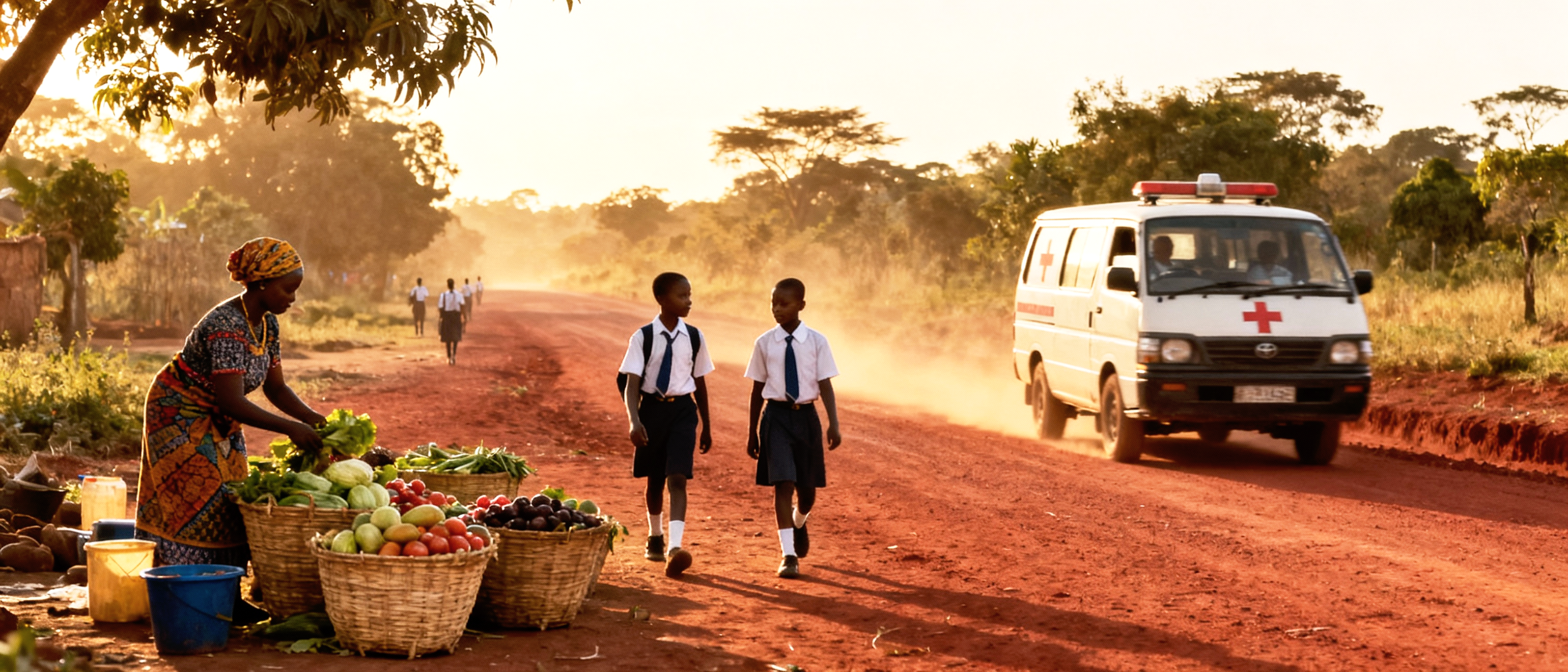
Sustainable Road Stabilization Initiative
The Sustainable Road Stabilization Initiative is a practical, evidence-led pilot to make unpaved rural roads safer, cleaner, and reliably passable across West Africa. We use environmentally safe soil stabilizers with basic drainage and local crew training. The result is a 50 to 70 percent cut in roadside dust, three to four additional months of road access each year, and at least a 20 percent drop in household transport costs. Each pilot site covers five to ten kilometers and serves several communities, with rigorous monitoring of air quality, road strength, access to clinics and schools, and maintenance savings. Your partnership turns a modest per site investment into measurable health gains, lower market prices, and a clear playbook that municipalities and national programs can adopt quickly. Join us to convert neglected corridors into lifelines for dignity, mobility, and economic opportunity.
Overview & Scope
Status
Ongoing, pilot planning and technical developmentRegion
West and Central Africa (urban and peri urban dirt side streets and home lanes)Pilot Scale
Up to 20 km (typical width 5 to 6 m)Timeframe
Approximately 24 months (6 plan and test, 12 build, 6 monitor and learn)
Technical & Costing
Treatments
• Option 1: Polymer or biopolymer stabilized base plus compacted wearing course
• Option 2: Same base plus single Otta or chip seal for rainy season reliabilityCost policy
• All planning and reporting in $ per m²
• Per km is for communication only
• 6 m width is about 6,000 m² per km
• 5 m width is about 5,000 m² per kmReference unit bands, works only
• Option 1: $2 to $4 per m² (midpoint $3)
• Option 2: $4 to $7 per m² (midpoint $5.5)
• Spot upgrade, double Otta or chip on short grades or turns $6 to $10 per m²
Beneficiaries & Reach
Estimated beneficiaries
• 15,000 to 20,000 residents per pilot cluster who rely on the treated corridors
• 3,000 to 5,000 schoolchildren with safer and more reliable trips
• 2,000 to 3,000 farmers and traders with improved access to markets
• Local contractors and municipal staff trained in stabilization, quality control, and maintenanceIndirect benefits
• Surrounding households with reduced spoilage and steadier supply chains
• Patients and vulnerable groups with more reliable clinic access
• Local governments saving on routine grading and graveling
Safeguards & Documents
Safeguards
Low impact works in existing right of way; ESF and ESMP, Labor and OHS, CHS; simple GRM
Documents
Project Concept (2 pages)
Technical Annex
Budget Assumptions
Safeguards and GRM Note
- Problem: In West Africa, hundreds of millions of people live beyond a 2 km walk of an all-season road. Unpaved corridors generate hazardous dust in dry seasons and become impassable in rains, undermining health, schooling, markets, and emergency response.
- Solution: Apply environmentally safe soil stabilization (polymer/biopolymer treatments with drainage and surface management) to strengthen unpaved roads, reduce dust, and extend passability.
- Pilot Scope: 3–5 communities, 5–10 km per site, diverse soils/rainfall regimes to build an evidence base.
- Budget & Timeframe: USD $100,000–$150,000 per site; 24 months (6 planning, 12 implementation, 6 monitoring/learning).
- Anticipated Impact: Cut roadside dust by 50–70%; extend passability by 3–4 months/year; reduce household transport costs ≥20%; halve routine grading; produce a scale-up playbook for national programs.
Vision and Innovation for Empowerment (VIE) is a registered nonprofit promoting sustainable development and access in West & Central Africa. VIE operates under IRS 501(c)(3) compliance and Texas nonprofit law, with bylaws, conflict-of-interest, and transparency safeguards. The mission emphasizes community-led design, evidence-based implementation, and partnerships with governments, research institutions, and international agencies.
- Access gap: Africa’s Rural Access Index (RAI, SDG 9.1.1) shows low values across West Africa, with hundreds of millions unserved by all-season roads.
- Health: Road dust (PM10/PM2.5) contributes to ambient air pollution, causing respiratory diseases and eye irritation; WHO links air pollution to >4 million deaths annually.
- Economic loss: Rough, impassable roads increase vehicle costs by 30%, reduce market access, and raise food and transport prices.
- Fiscal strain: Governments spend heavily on regrading and graveling without long-term results.
Goal: Improve health, mobility, and economic resilience by stabilizing rural roads.
Objectives:
- Reduce roadside dust (PM10/PM2.5) by 50–70%.
- Extend road passability by 3–4 months annually.
- Cut household transport costs by ≥20%.
- Halve grading/maintenance frequency.
- Produce policy-ready evidence for national and regional scaling.
- Direct: 15,000–20,000 residents, 3,000–5,000 schoolchildren, 2,000–3,000 farmers and traders, local contractors/municipal staff trained.
- Indirect: Families in surrounding regions, patients accessing clinics, local governments saving on maintenance budgets.
- Site Selection: Prioritize communities with high health/economic impact potential; diverse soils (lateritic, clay, sand).
- Soil Testing & Feasibility: Lab and field tests (UCS, CBR, plasticity, moisture) to match stabilizers.
- Pilot Implementation: Apply polymer/biopolymer treatments, compact, cure, add spot drainage and traffic management.
- Capacity Building: Train contractors and municipal crews in safe application, QA/QC, and maintenance.
- MEL: Monitor dust (PM), road strength, days passable, costs, and user experience over 12–18 months.
- Scale-Up Framework: Translate results into national specifications and ECOWAS knowledge platforms.
Indicators:
- Roadside PM10/PM2.5 concentrations.
- Road passability (days/year).
- Soil strength (UCS/CBR).
- Maintenance frequency and cost.
- Household transport costs and travel times.
- School attendance and clinic visit reliability.
Methods: Portable PM monitors, geotechnical tests, condition surveys, focus groups, household cost tracking.
| Category | USD | % of Total |
|---|---|---|
| Soil testing & baseline data | 10,000 | 8% |
| Stabilizer materials & transport | 40,000 | 30% |
| Road works & application | 50,000 | 35% |
| Training & capacity building | 15,000 | 10% |
| Monitoring & evaluation | 20,000 | 15% |
| Administration & reporting | 5,000 | 2% |
| Total | 140,000 | 100% |
| Phase | Duration | Dates |
|---|---|---|
| Planning & Feasibility | 6 mo | Jan–Jun 2025 |
| Pilot Implementation | 12 mo | Jul 2025–Jun 2026 |
| Monitoring & Learning | 6 mo | Jul–Dec 2026 |
| Scale-Up Design | 3 mo | Jan–Mar 2027 |
| Risk | Likelihood/Impact | Mitigation |
|---|---|---|
| High cost/import dependency | Med/High | Regional sourcing, biopolymer options, bulk procurement |
| Early rainfall/cure failure | Med/Med | Dry-season scheduling, site protection, QC protocols |
| Environmental concerns | Low/High | Certified products, water/soil monitoring, safeguards |
| Limited government buy-in | Med/High | Engage ministries early; align with national strategies |
| Variable soil performance | Med/Med | Site-specific tests, adjust dosage/method, add drainage |
Sustainability: Train municipal crews; integrate into routine works and budgets; document O&M manuals.
Scalability: Package results into procurement-ready specs and playbooks; align with ECOWAS Regional Infrastructure Master Plan and national rural road programs.
- Governments/municipalities: Corridor selection, co-financing, maintenance.
- Development banks/agencies: World Bank, AfDB, bilateral donors for financing and scale-up.
- Universities/research institutes: Testing, evaluation, data management.
- Private sector: Stabilizer suppliers, logistics, QA.
- Civil society: Community engagement, accountability.
- SDG 3 – Good Health and Well-Being: Reduced dust exposure, safer travel.
- SDG 9 – Industry, Innovation and Infrastructure: Contribution to SDG 9.1.1 (RAI).
- SDG 11 – Sustainable Cities and Communities: Inclusive access.
- SDG 13 – Climate Action: Reduced gravel extraction, lower erosion, adaptation resilience.
The Sustainable Road Stabilization Initiative offers donors and partners the chance to transform rural mobility into a driver of health, dignity, and economic opportunity in West Africa.
Detailed technical annexes, unit-cost assumptions, MEL frameworks, and site selection templates are available upon request.